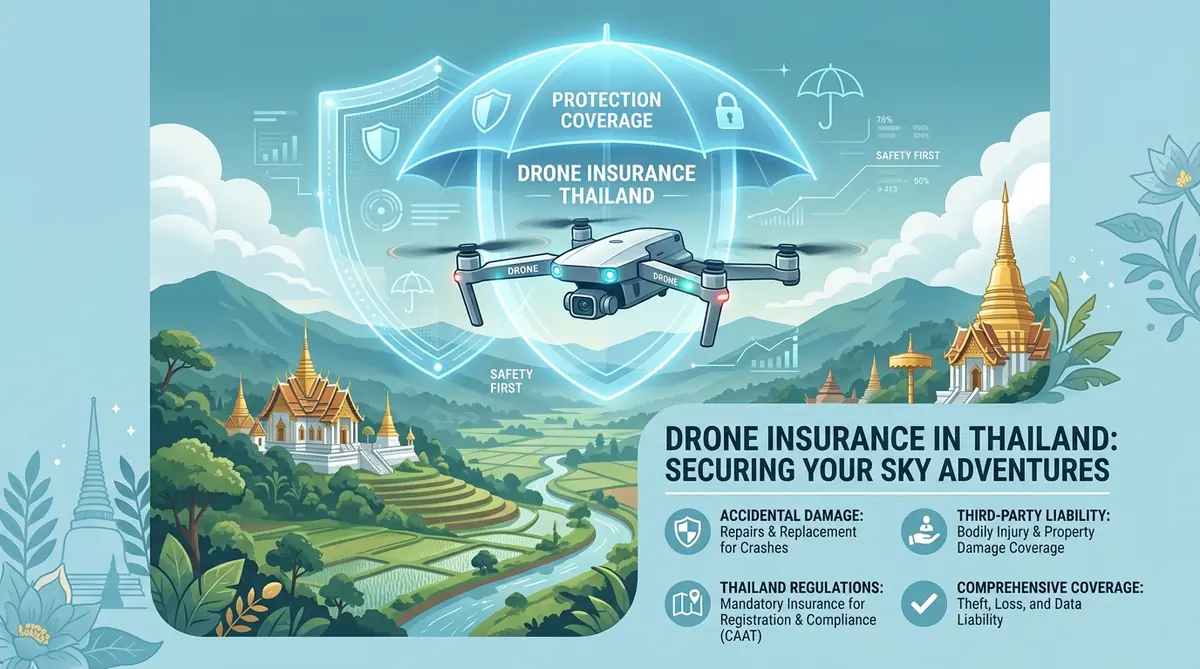
People often confuse (Third Party Liability) and (Hull Insurance). This article clearly explains the difference.Third-party liability insuranceHull insurance
Thai law "mandates" only one type of drone insurance, but the other type can save you tens of thousands to millions of baht when an accident happens. This article compares them point by point and recommends the plan that suits you.
What is third-party liability insurance? (Required by law)
Covers damage caused by your drone, such as the drone falling on a person or colliding with a car. RRCT coverage limits:For someone else1,000,000 baht
CAAT clearly states that an applicant for drone pilot registration must have a policy covering damage to the body, life and property of third parties, with coverage of — if you do not have one, you will The policy is valid for 1 year and must be renewed at least 30 days in advance, then the new policy updated in the UAS Portal system.No less than 1,000,000 baht per incidentYou cannot apply for the CAAT license in the first place
An example that can easily happen: you fly to shoot scenery over the Chao Phraya River, the signal drops, the drone falls and shatters someone else's car windshield — without insurance, you have to pay tens of thousands of baht in damages yourself, plus the cost of repairing your own drone on top of that. Read more at Is drone insurance necessary? Everything you need to know before flying
What Is Hull Insurance? (Not Mandatory)
Covers if the DJI Neo crashes: 10,000 baht | Mini: 30,000 baht | Air/Mavic: 70,000 bahtYour own drone
Hull insurance covers accidents that happen to your own drone, such as crashes, hitting a tree, or falling into water. It is not mandatory but strongly recommended, because DJI drone repair costs are very high — from around 10,000 baht for small models to over 50,000 baht for pro models. RRCT's Premium plan takes 100% responsibility for damage exceeding 10% of the insured amount, while the FPV family (e.g., DJI Avata 2) offers hull coverage of up to 70,000 baht. Read more at Registering FPV drones and the DJI Avata 2
Comparison table: third-party insurance vs. hull insurance
| Topic | Third-party insurance | Hull insurance (Hull) |
|---|---|---|
| What is covered | The body, life and property of others that the drone damages. | your own drone, when it crashes, hits a tree, or falls into water |
| Legal status | Mandatory — required as part of CAAT registration. | Not mandatory, but recommended for high-value drones. |
| RRCT's coverage limits | 1,000,000 baht per occurrence | By model: Neo 10,000 / Mini 30,000 / Air–Mavic 70,000 THB |
| Who receives the compensation | Third parties who suffer damage | yourself as the aircraft owner |
| Which package is it included in | All packages, including Standard (starting at ฿1,299) | Premium packages (Premium Mini ฿4,399 / Premium Pro ฿6,399) |
Which one should you choose?
- Drones priced under 10,000 baht: Standard ฿1,299 (third-party liability only)
- Drones priced 10,000–30,000 baht: Premium Mini ฿4,399
- Drones priced 30,000 THB or more: Premium Pro ฿6,399
What happens if you have no insurance at all?
Without third-party insurance you cannot register with CAAT, and flying without a license is an offense under the Air Navigation Act, punishable by up to 1 year in prison or a fine of up to 40,000 baht, or both. More serious is civil liability — if your drone falls on a person or someone else's property, you must pay all the compensation yourself, which could amount to millions of baht. For commercial work, coverage should be increased to 5–10 million baht. Read more at Commercial drone flying in Thailand
RRCT offers both third-party liability insurance and hull insurance in a single package.
Summary
Third-party liability insurance is mandatory under CAAT law, while hull insurance is suitable for expensive drones. RRCT offers packages that include both.
If you're not yet sure which plan fits, message RRCT on LINE and tell us your drone model and how you use it — the team advises for free. The policy is valid for 1 year and must be renewed together with the CAAT licence every year. See the steps at How to renew your CAAT drone licence and keep your NBTC (คท.30) registration current
Frequently Asked Questions (FAQ)
How necessary is third-party insurance under the law?
Absolutely essential. CAAT requires registration applicants to hold a third-party liability policy of no less than 1,000,000 THB per incident. Without one you cannot apply for the license, and flying without a license carries a penalty of up to 1 year in prison or a fine of up to 40,000 THB.
Who is hull insurance (Hull) suitable for?
Base it mainly on the price of the drone. For drones under 10,000 THB, the Standard plan is usually enough. For prices of 10,000–30,000 THB and above, we recommend Premium Mini / Premium Pro, which include hull insurance, because repair costs for mid-range to pro models can reach 50,000 THB.
If a drone falls into water or hits a tree, will the insurance pay?
Third-party insurance does not pay out, because it only covers damage to others. But if you have hull insurance (Hull), accidents such as a drone crash, hitting a tree, or falling into water are covered. RRCT's Premium plan covers 100% of damage exceeding 10% of the insured amount, up to the limit for each drone model.
Can foreign drone insurance be used to apply to the CAAT?
Possibly, but the policy must clearly state that it covers third-party liability in Thailand, with coverage of no less than 1,000,000 baht (about 30,000 US dollars), and it must be translated into English or Thai. Many people find that getting Thai insurance is easier and cheaper.
How long is drone insurance valid, and when must it be renewed?
A third-party liability policy is valid for 1 year. You should renew it at least 30 days in advance and always update the new policy in CAAT's UAS Portal system, because the CAAT license is tied to insurance that has not expired. If you let it lapse and then fly, the flight is considered unlawful.